When AI Agents Start Building 3D Worlds
Over the past two months, I ran a batch of 3D architecture and terrain experiments inside MinePilot. Going in, I assumed different models would split cleanly by strength: Claude Opus or Fable for spatial design and proportions, Codex Astra for heavy geometry and code. After shipping ridge sanctuaries, delta wetlands, a night-lit Tang palace district, and two full-scale statues, Gemini Carbon surprised me. Across 3D massing, sculpting math, player-eye sightlines, and in-game debugging, it handled nearly every stage of the loop.
Still, a model leaderboard is the least useful story here. Key pieces of our tooling and QA came from Fable, Opus, Sol, Argon, Dot, and Hydrogen working in distinct roles. What actually changed my thinking was one cave behind a waterfall.
In the first draft (R1) of Stratafall Ridge Sanctuary (T01), the hero overview looked ready to ship: twin cascades, a stone viaduct across a gorge, and a two-story hall below a bell tower. As a single-camera web demo, it would have passed on the spot.
Then Argon, reviewing independently, dropped the camera to player eye height (eye-06) inside the “waterfall grotto” and checked the columns overhead. Sixty-nine columns opened straight to the sky. The cave had no roof. It wasn’t behind the main waterfall either; to fake a water curtain from one angle, the script had hung a side cascade in mid-air. Out on the bridge, a cutout box (void.reveal-sightline) meant to clear the hero view had sliced through the viaduct deck and parapet, leaving two lanterns floating in space. Our diff check still reported collateralCells = 0—because the author had explicitly declared that cutout box. Only after a local source repair (R1 → M0), checked in same-camera proxy renders and then inside the live Java client, did the grotto hold up at eye level.
Figure 1: Same-camera T01 R1 → M0 repair comparisons (see the bottom eye-06 grotto row). These are proxy renders of the frozen models, not native Minecraft screenshots; open the full-size image on mobile to inspect details. View full-size image
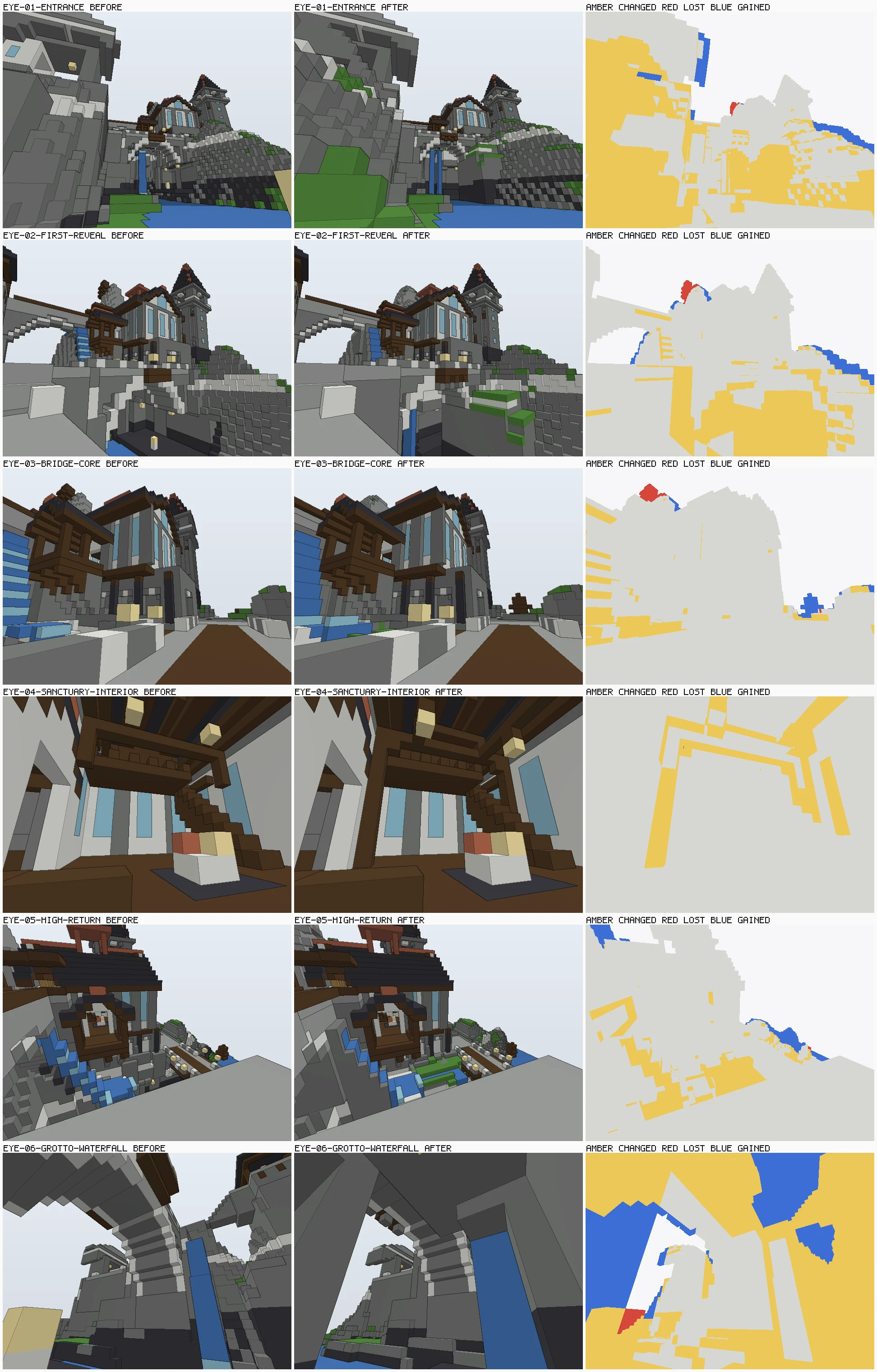
Figure 2: Player-eye view (eye-06) inside the repaired waterfall grotto of Stratafall Ridge Sanctuary, captured in native Minecraft Java 26.3 (shaders off).
The infrastructure I had built for agents was only half finished.
A Compiler Proves Validity, Not Space
In Building a Domain Harness for AI Agents, I summed up our early architecture in one line: Agent is the author. Engine is the compiler.
Real-time Minecraft bots stall easily when tracking 3D state block by block, while raw .schem files are too low-level to write by hand. So I extracted and open-sourced our voxel engine, CraftDAG, keeping MinePilot as our private catalog, preview, and review system. For ordinary buildings, CraftDAG runs a clean semantic pipeline:
BuildIntent → ComponentPlan → CraftDAG IR → VoxelPlan → Sponge .schem
The agent writes RoomShell, Door, and GableRoof components with relations like anchor, wall, offset, and overhang. The compiler checks bounds and dependencies, lowers everything into integer VoxelPlan coordinates and .schem files, and returns structured repair hints on error. That worked well for houses, towers, and modular landmarks like the Roman Colosseum.
Once a build merges architecture with cliffs, rivers, caves, bridges, night light, or human drapery, “it compiles” stops meaning “it works.” A compiler can prove that every block stays in bounds, zero blocks float, and a million cells round-trip through .schem export with zero diffs. It cannot prove that a cave has a ceiling, that a balcony view clears its own railing, or that a Nether fortress looks like a gatehouse rather than a brick power plant. Just as tsc passing does not prove a web page isn’t blank, a voxel compiler cannot judge sightlines, negative space, or proportion.
Why This Is Harder Than a Pretty 3D Preview
People often ask why Minecraft builds need so much machinery when an LLM can write a nice Three.js scene in one pass.
The difference comes down to the acceptance contract. A showcase scene ships meshes, lighting, and one or two camera angles. A downloadable .schem blueprint has to satisfy six constraints at once:
- 3D topology and negative space: Rooms, caves, and stairwells are enterable air volumes, not outer shells. Caves need closed vaults; bridges must meet cliffs; arches must hold their shape on a 1-meter grid.
- Discrete BlockState compilation: Coarse forms or meshes must compile to exact
BlockStates—stair facings, slab halves, wall connections, water levels, lights, and protected air. - Player-scale reachability: Flying cameras lie. A
0.6 × 1.8player hitbox needs solid footing, stair headroom, guardrails, and a connected loop back to the entrance. - Game-native physics: Browser WebGL / Deepslate previews are static. In live Minecraft Java, fluid ticks spread water, neighbor updates pop unsupported blocks into item drops, and chunk reloads test state stability.
- Bounded local repair: When one parapet blocks an eye-level shot in a 150,000-block build, the agent must trace pixels back to a named region (
pick -> edit -> diff -> re-render), preserveprotected AIR, and fix that parapet without touching nearby halls. - Separate quality gates:
TECH,ART,NATIVE_STATE,PLAYABILITY, andTRANSFERstay distinct. Zero state diffs andCONNECTEDstatic graphs do not mean a build looks good or walks cleanly in Survival.
Expensive Detours: 2D Concept Art, View Tunnels, and Green-Light Illusions
Three failed experiments shaped our workflow more than any single success.
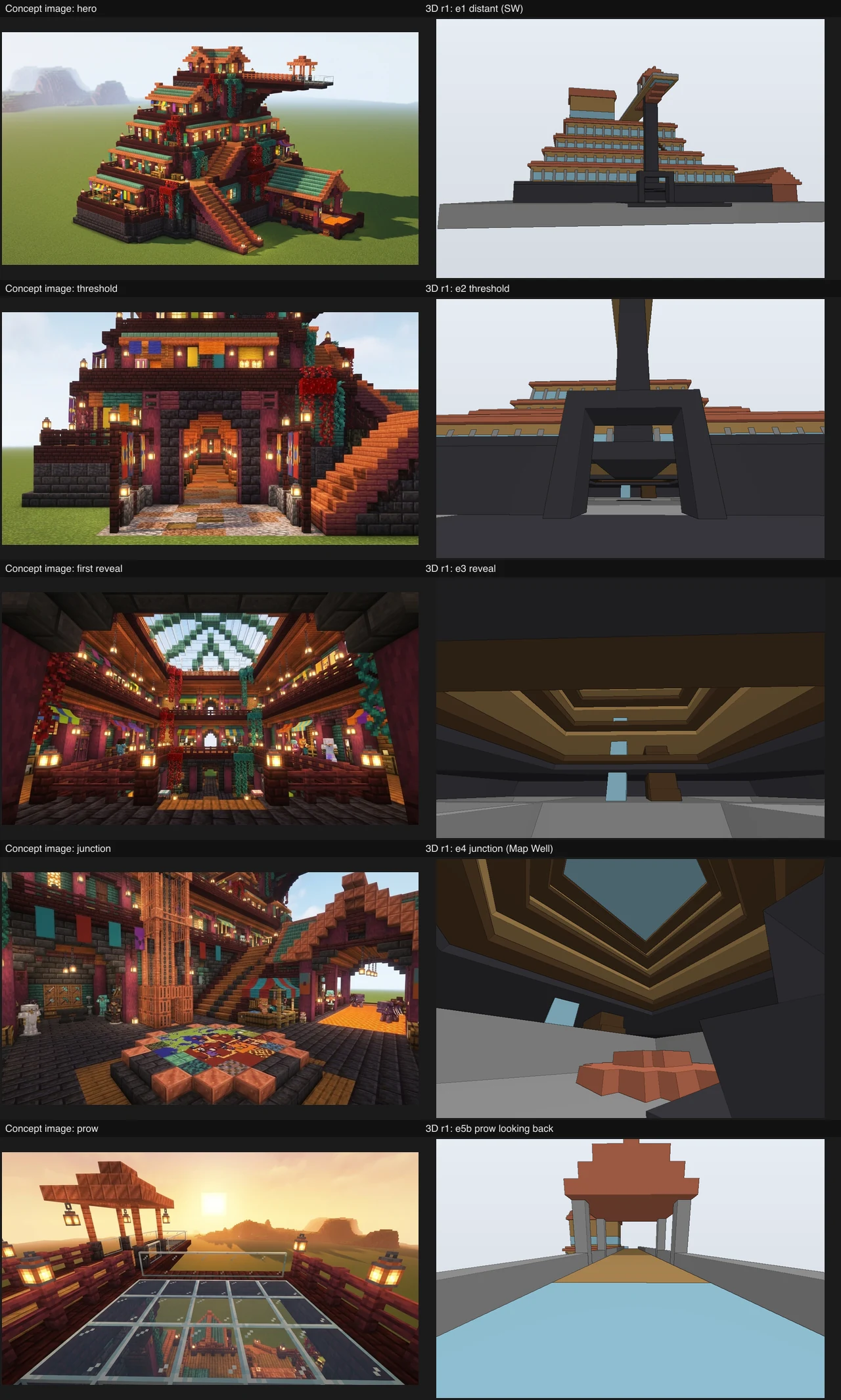
2D concept art is not a 3D design source. During our Nether landmark tests (N01, later published as The Lodestone Plumb), Opus built an end-to-end candidate (Cinder Gate, ~110,000 blocks, zero server diffs) that looked like a black-brick power station (ART 49/80). Having Opus and Carbon paint 2D concept art first on N01 made things worse: single paintings left backsides and sections undefined, turning cantilevered terraces into symmetric stepped pyramids, while multi-view 2D packs contradicted themselves across angles. A 3D build has to start from 3D massing, plans, and sections.
Figure 3: Opus N01’s 2D concept image versus its actual editable 3D model. The spatial promise of the painting did not survive translation into a 3D source; this comparison is not native-game acceptance evidence. View full-size image
Extreme camera-first design creates view tunnels. Locking camera frustums too early produced View-Corridor Tunnel Bias: one detailed corridor straight ahead flanked by blank side walls, or an eye-05 camera staring mostly into empty sky before massing settled. Spatial hierarchy and landmarks must lead (Design-First), with player cameras checking sightlines afterward.
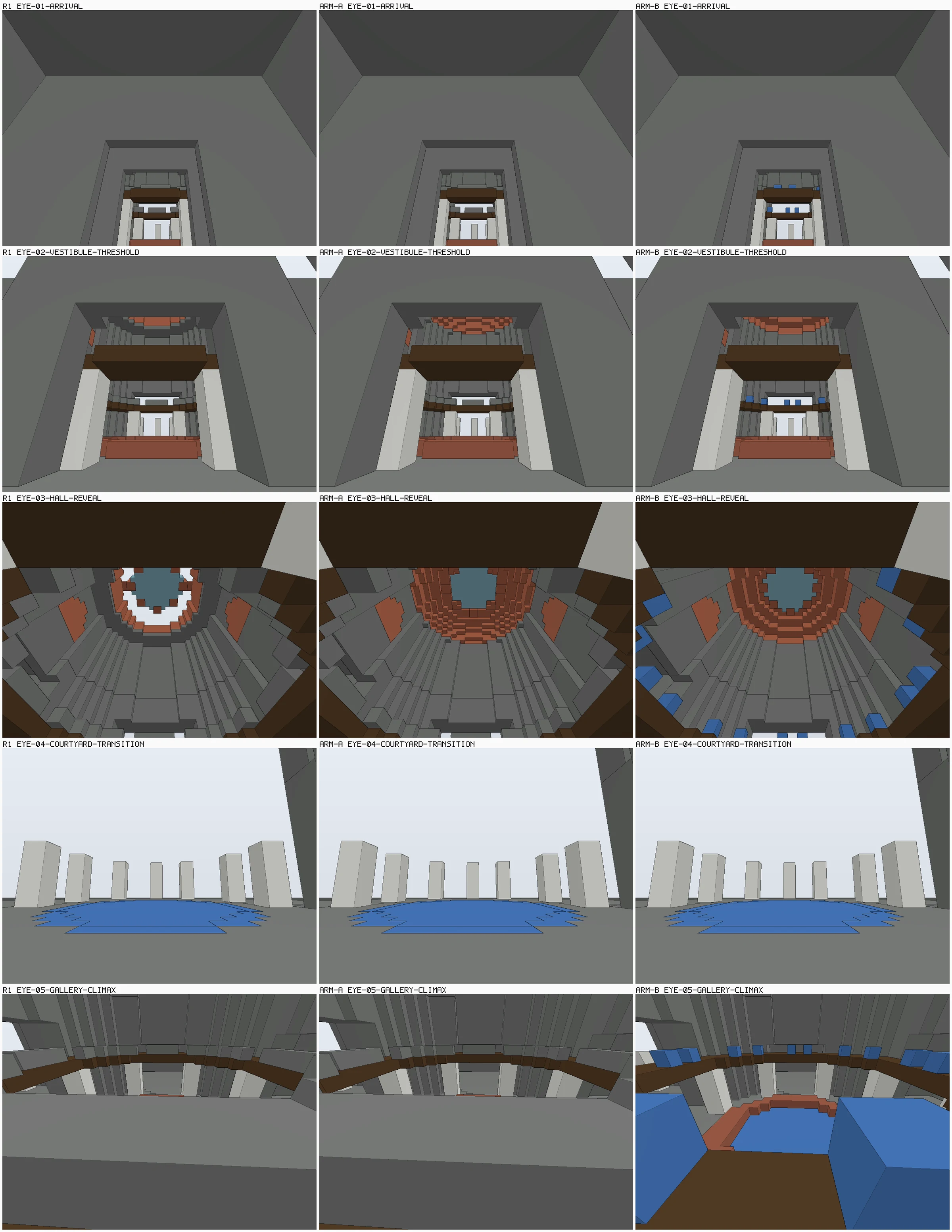
A green CLI exit code is not seeing. After Fable built architecture.region-blockout (protected AIR, fixed cameras, pick -> edit -> diff), Argon used it on an Art Nouveau bathhouse (R1). Because cli.mjs render exited 0 with RENDERED and eyesInSolid: [], Argon assumed the views passed. In views.json, however, the main pool overlook eye-05 was 62.49% blocked by a solid stone railing, leaving 0.00% of the water visible beneath U-shaped roof holes.
To see whether self-review could catch what the CLI hid, we ran a controlled follow-up (R07) giving two isolated Argon sessions one bounded revision on that frozen R1 model. The Self-Critique arm patched only the roof dome and dismissed the solid wall as normal foreground (0.00% water visible). The Critic-Assisted arm received a structured defect list from an isolated critic, replaced the solid ring wall with open balusters, and lifted pool-water visibility to 5.23% in proxy renders (windowless outer walls still kept the study out of native testing).
Figure 4: Fixed-camera proxy renders from the R07 study across R1, Self-Critique, and Critic-Assisted variants (focus on the eye-05 pool-overlook row). Pool-water visibility stayed at 0% under self-critique and rose to 5.23% with independent critique; these are not native-client tests. View full-size image
That experiment drove two changes: render stdout now prints each player camera’s top visible regions alongside visualQuality: NOT_ASSESSED, and complex flagship builds trigger an independent visual critic instead of relying on author self-grading.
Closing the Loop Across Three Authoring Routes
Rather than forcing every build into one DSL, we choose the authoring route on top of CraftDAG by geometry:
- Semantic
ComponentPlanfor modular buildings with clear rooms, bays, and roofs; - Named Region Blockout +
protected AIRfor terrain complexes where cliffs, water, bridges, and interiors interlock; - Sculpt-First
.objmeshes for curved monuments and human figures, compiled intoVoxelPlanvia sub-voxel sampling.
Ordinary modular builds take the fast deterministic compile path. Complex terrain scenes and flagship monuments run through the full loop below, triggering early concept screening and independent visual critique when spatial risk is high:
flowchart TB
    Intent["Design Intent and Real References"] --> Coarse["Plans/Sections + Coarse Editable 3D Source<br/>ComponentPlan / Region Blockout / Sculpt OBJ"]
    Coarse --> Inspect["Source-Bound Fixed and Player-Eye Views<br/>Region Pixel Telemetry + Protected AIR + Hitbox Support"]
    Inspect --> Critic["Independent Agent Critique (Complex Flagships)<br/>Separating TECH from ART"]
    Critic -->|"Occlusion, roofless void, or bad massing"| Repair["Bounded Local Repair<br/>pick -> edit -> diff -> re-render"]
    Repair --> Inspect
    Critic -->|"Design GO"| Compile["Deterministic BlockState and Sponge .schem Compile"]
    Compile --> Native["Native Minecraft Java 26.3 QA<br/>WorldEdit Paste / Fluid Ticks / Reload / Survival Walk"]
    Native -->|"Item drops, leaks, or blocked walk"| Repair
    Native -->|"5-Gate Evidence Locked"| Review["Human Review and Public Release"]
The rule is simple: catch spatial mistakes in a few hundred lines of coarse source, never by pasting trim onto 150,000 finished blocks.
Five Shipped Worlds—and Where Each One Stops
With that loop running, Carbon and its peer agents shipped five flagship builds now live on MinePilot, each keeping explicit verification boundaries.
1. Stratafall Ridge Sanctuary (T01)
After Argon’s initial HOLD, Carbon repaired T01 in place: closing the grotto under a thick deepslate vault, grounding the waterfall curtain in front of the arch, pulling back void.reveal-sightline to restore the bridge parapet, and sealing the river-mouth banks.
The published Stratafall Ridge Sanctuary (157,662 blocks) round-tripped through .schem export with zero diffs. In live Minecraft Java 26.3, over four thousand water blocks settled within 20 ticks without indoor leaks, and a client Survival walk completed the 550-step loop without teleports. Argon’s final QA (ART 77/100 PASS, re-verifying the build scripts and hash-bound native receipts without launching a second client run) kept the remaining quirks on record: a flat west tuff trench, a planar north back-slope, and test-valley hills outside the .schem. On T01 alone, cross-terrain transfer stayed UNVERIFIED.
2. Reedglass Delta Conservatory (T02)
To test transfer on opposite terrain, Reedglass Delta Conservatory traded T01’s deep gorge for a flat braided delta with only +7 blocks of natural relief, pairing a sluice weir with an elevated glass conservatory on flood piers. We ran it as a cross-model relay: Carbon D1 design → Dot D1 gate → Argon S1 build → Dot art review → Argon F1 finish → Dot final QA.
At D1, Dot caught a classic false green light: eye-06 reported eyesInSolid = 0 while hovering over open water with air underfoot. Carbon patched the boardwalk locally and added 0.6 × 1.8 foot-support checks. After Argon built S1 and passed live water and Survival checks, Dot held ART at 71/100 (excluding the outer test-host wall): reed clumps looked like boxy leaf cubes, interior floors felt bare, and a bright white iron_block catwalk overpowered the glass vault.
Figure 5: Same-camera native Minecraft Java 26.3 comparison of Reedglass Delta Conservatory, S1 → F1 (see the eye-04 catwalk and wetland bank rows): dark deepslate rims and spruce decking replace the white iron catwalk, alongside richer interior and wetland planting. View full-size image
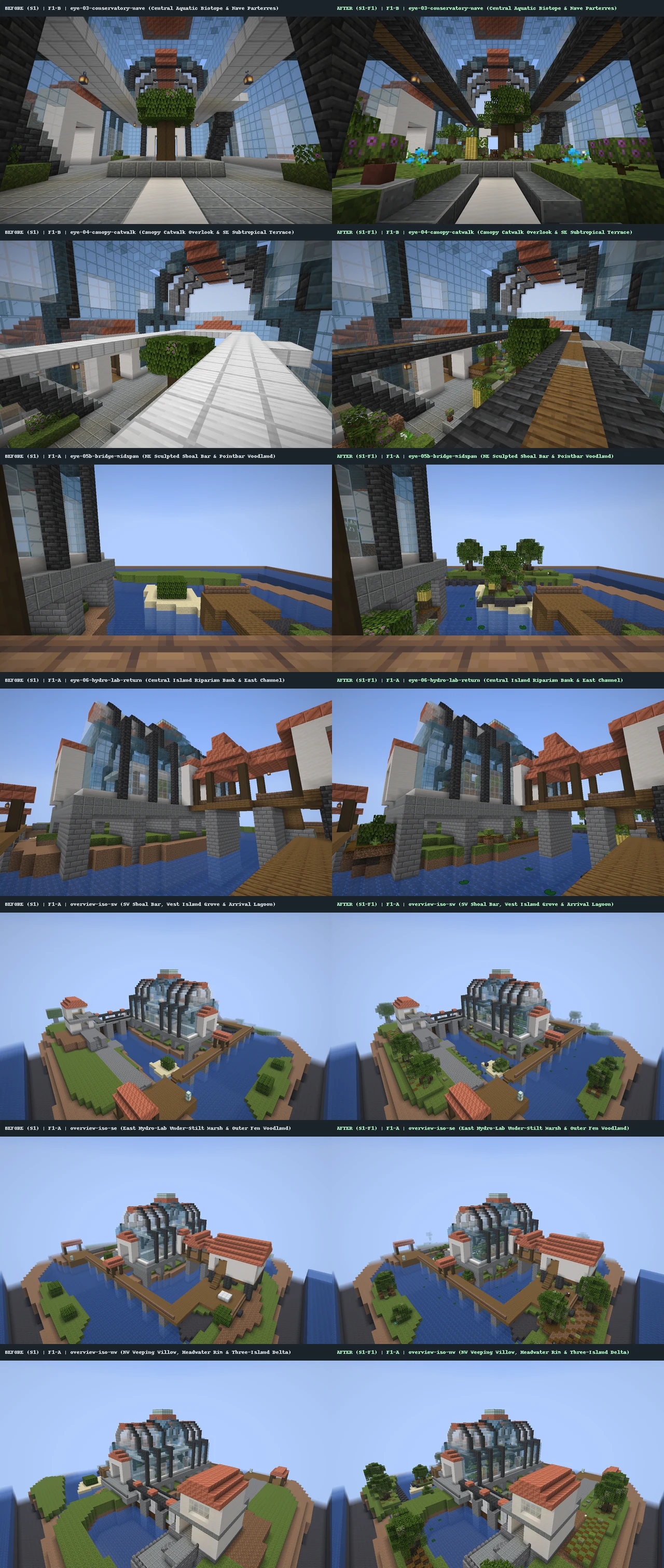
Because every region was named, Argon needed just one bounded finish pass: swapping the catwalk to dark deepslate_tiles rims and warm spruce_planks decking, adding mangrove prop roots and weeping willows, and leaving the water and walkable route untouched. Dot raised ART to 78/100 PASS and marked TRANSFER: VERIFIED_SCOPED—noting honestly that the 404-step Survival trace was tool-driven rather than manual keyboard play, running under llvmpipe software rendering.
3. Lanterns of Chang’an
Lanterns of Chang’an (334,073 blocks) tested a High Tang palace district at night under one rule: Shaders OFF, zero post-processing, vanilla Java 26.3 lighting only.
An early pass stuffed invisible minecraft:light blocks around the halls, accidentally overwriting 75 structural blocks while leaving upper roofs dark. Carbon’s Festival of Ten Thousand Lanterns scheme lit buildings from within instead: recessed froglight and shroomlight mullion windows, eave lanterns, gentle ridge grazing without upper-roof blowout, street lantern wheels, and lotus lamps along the canal.
Figure 6: Lanterns of Chang’an at night in vanilla Minecraft Java 26.3 (shaders off).
Live Java 26.3 then caught what static web previews missed. Right after WorldEdit paste and neighbor updates, 203 hanging lanterns popped off into dropped items—they hung under azalea_leaves and slab[type=top] blocks that fail vanilla bottom-support rules. Argon swapped those mounts for mangrove_wood boughs and solid timber beams, cleared two canal trees blocking a bridge view, and added canSupportLantern to static QA. On retest, all 1,633 lanterns held (0 drops).
4. Statue of Liberty and Christ the Redeemer
Curved landmarks exposed the limits of box primitives. On the Taj Mahal, Codex Astra ran four iterations before shipping only a bounded taj-mahal-study upgrade (ART 72/100). Figurative statues were harsher: early Liberty runs mirrored the torch onto the left arm, rendered pure-sky screenshots until Sol fixed a headless chunk-cache bug, and lost all 0/7 crown windows in the early sculpt source. Fable’s anatomy diagnosis and head study confirmed that patching coarse voxel masks could not preserve facial planes and small openings together.
Carbon switched to Sculpt-First: generate a watertight multi-role .obj mesh in Python/C with lofted facial planes and classical drapery, check eight clay views first, then compile into VoxelPlan and .schem using sub-voxel sampling, role priority, and protected AIR (with regression tests keeping the crown windows open). Each candidate was checked in Deepslate/WebGL previews before entering native Java 26.3.
Figure 7: Statue of Liberty across editable .obj sculpting, voxelization, and Deepslate/WebGL previews. This board documents the modeling and translation pipeline; it is not a board of native Minecraft screenshots. View full-size image
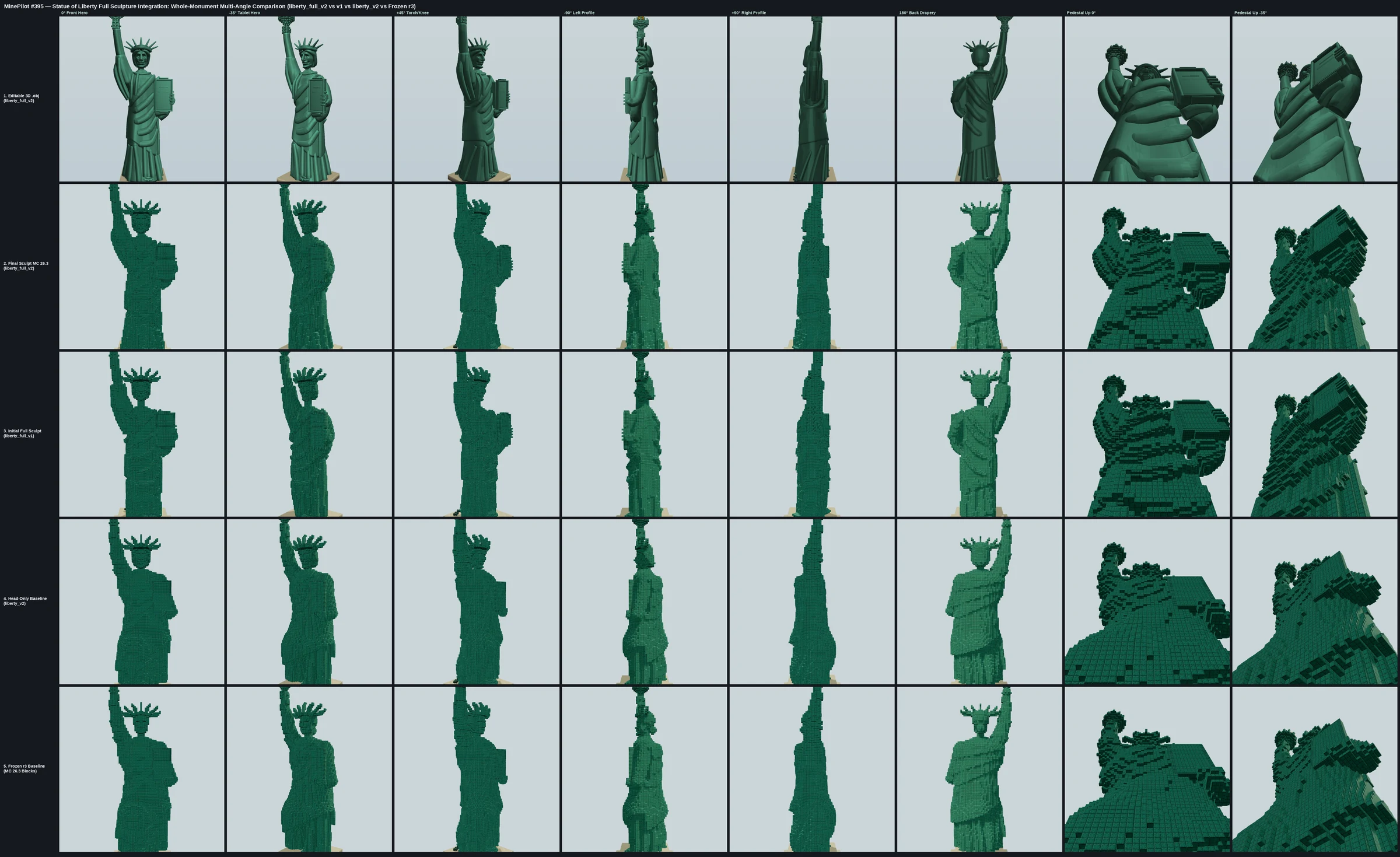
That pipeline delivered two live monuments: Statue of Liberty (208 blocks tall, 124,954 blocks, separated seven-ray crown and forehead windows, ART 90/100) and Christ the Redeemer (100,099 blocks atop Corcovado peak, ART 92/100 after a v1 -> v2 tweak deepened the hanging sleeves and soapstone flutes).
Figure 8: Northwest overview of Christ the Redeemer and its Corcovado mountain base in native Minecraft Java 26.3, not a player-eye shot from the summit terrace.
Both keep clear playability boundaries: Liberty’s keyboard Survival walk covers only the ground pedestal hall, and Christ’s climb ends on the outdoor 360° summit terrace—neither carves fictional rooms inside the crown or arms. Even above 90/100, figurative-sculpt-first stays L1 Experimental.
The Glacier Carbon Held On—and Changing the Geometry
On the same day Liberty and Chang’an wrapped, Carbon’s third terrain scene—T03 Glacial Crevasse Observatory—progressed from an initial R1 hold through M1-A camera diagnostics and fracture remassing into a full M1-B source model, only to be halted by Dot at D1_DESIGN_HOLD_FINAL.
On static engineering checks, M1-B was spotless: 261,462 occupied blocks with zero .schem diffs, intact protected AIR, grounded structural chains, a 380-step static route, and a convincing copper dome and sub-glacial ice arch (E06). Yet Dot’s blind review of the clay boards and eight player views scored M1-B’s D1 design potential at 74/100 and stopped it before S1 detailing or native testing. The aboveground glacier walls still looked like planar retaining wedges with repetitive steps, terrace E05 stared into dark wall proxies and empty sky, and a bulky central telescope pier blocked room E07.
Figure 9: Design-stage clay renders compare T03’s glacier massing and silhouettes across R1, M1-A, and M1-B. M1-B’s 74/100 is a D1 design-potential score, not a native Minecraft ART score; this candidate did not enter native Minecraft or Survival testing. View full-size image
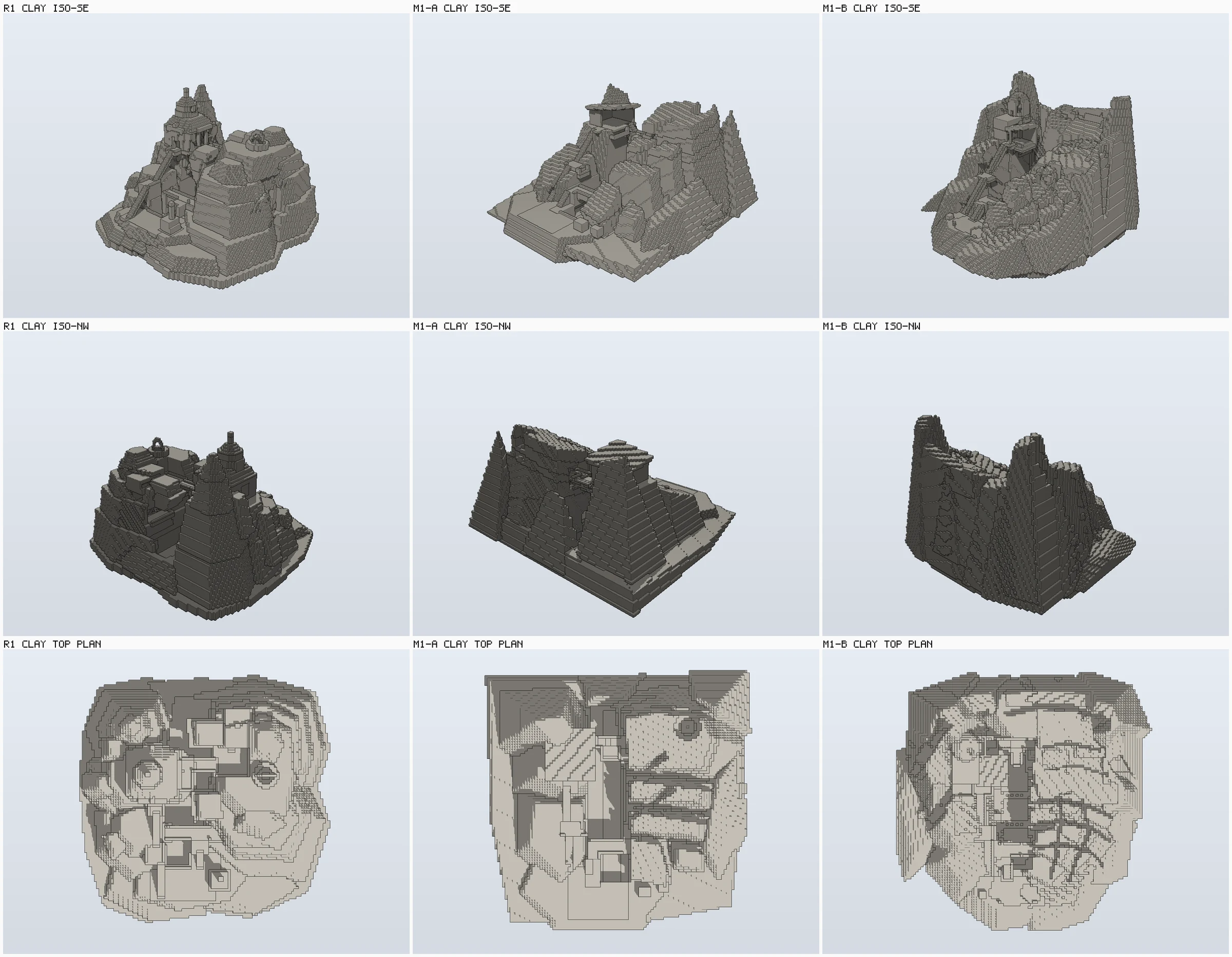
Stopping M1-B there mattered more than forcing a pass. Two months ago, sinking 260,000 error-free blocks into a scene would have tempted us to slap ice-brick trim onto bad massing. Separating TECH from ART froze M1-B cleanly at the clay stage and forced a change in geometry representation instead. In a follow-up method track (M2-A → M2-B), Carbon traced the retaining-wall look to steep ~80° convex CSG half-spaces that had left an eighty-plus-block unbroken north wall. Replacing that shell with an erosion-first concave alpine envelope co-designed around the sub-ice vault and ice arch broke the north wall with a glacial pass, gave the northeast horn asymmetric plucked-cliff and dip-slope faces, and re-aimed terrace E05 and an off-axis E07 refractor across near crevasse, mid seracs, and far peak. As this note is drafted, the new M2-B source candidate has just entered Dot’s blind D1 review—still unapproved on ART and untested in native Survival, yet already a cleaner answer than decorating a flawed wedge.
Looking back at my initial surprise—why Gemini Carbon felt so well-rounded across most of these builds—I only have a working hypothesis. In our runs, different models showed distinct leans: Claude Opus and Fable excelled at symbolic abstraction, tool design (region-blockout), and structural diagnosis, though when Opus generated a full landmark solo, its symbolic structure could outrun its visual eye; Carbon felt unusually steady across sculpting math, block-state contracts, and eye-level screenshot inspection. My guess is that Google’s early bet since the Gemini 1.0 report on joint multimodal pretraining from the ground up may be paying compound interest once reasoning and tool use caught up. Still, project runs like ours cannot separate pretraining architecture from Domain Harness design, tool telemetry, or thinking budgets—and T03’s M1-B hold showed that no model gets spatial form right for free.
In When Software Stops Needing So Many Software Engineers and Where Jev Fits, I wrote about dividing work between deterministic code, bounded harnesses, and human judgment. Wiring spatial observation, on-demand independent critique, local repair, and native game physics into our Domain Harness let agents carry far deeper 3D work than I expected six months ago—focusing my attention on taste, honest boundaries, and knowing when to change the geometry rather than polish a glacier.
Which leaves a broader question. Coding benchmarks test whether an agent satisfies compilers and tests; image and video models test whether one frame looks convincing. Could 3D world construction—where an agent must conceive a space, compile it into discrete physical rules, walk through it at eye level, repair local flaws without collateral damage, and pass both native physics and independent critique—become one of the clearest proving grounds for general agent capability?
Related Resources & Live Builds:
- MinePilot Official Website (Live builds: Stratafall Ridge Sanctuary · Reedglass Delta Conservatory · Lanterns of Chang’an · Statue of Liberty · Christ the Redeemer · The Lodestone Plumb)
- CraftDAG Open-Source Voxel Engine (GitHub)
- Earlier essays: Building a Domain Harness for AI Agents · When Software Stops Needing So Many Software Engineers · Where Jev Fits